Showing posts with label program officer. Show all posts

Wednesday, March 19, 2014

What’s Wrong with a Standard of ‘Excellence’ in Grantmaking?


The role of the nonprofit sector is to address the kinds of problems that haven’t been able to resolved in the consumer-driven marketplace. This concept has been well described by economists such as Hansmann (1981) who called this contract failure to imply individual consumer’s unwillingness to pay for goods and services that are for the benefit of all. More colloquially, we call this the tragedy of the commons wherein goods and services that benefit the masses cannot be sold through a capitalistic approach. The nonprofit sector exists, then, to correct marketplace failures so that the things that are good for society—environmental conservation, cultural expression, and opportunities for advancement by those who are poor—actually get addressed. Hence, the nomenclature of nonprofit is not to imply an inability to retain a profit, after all, every enterprise needs a financial surplus to be sustainable and vital, but rather to describe activities that exist outside of profit-making motives.

Because nonprofit entities are responsible for redressing problems that have failed to be addressed in the marketplace, private foundation grantmakers should be wary of incorporating competition-based approaches in their practices. Merit-based decision-making has been repeatedly shown to be inadvertently discriminatory: “According to the ideology of meritocracy, inequality is seen to be fair because everyone presumably has an equal (or at least an adequate) chance to succeed, and success is determined by individual merit (McNamee & Miller, 2009, p. 4).” In other words, if meritocracy worked—that is, if everyone enjoyed fair and equal opportunities based on a level playing field—then there really wouldn’t be a need for charitable and philanthropic entities to exist. The proprietary sector would be an effective place for everyone to be able to rise out of poverty. But we know that for those who struggle, the opportunity to make money is not fairly distributed. Therefore, why do private foundations apply the same marketplace-based principles and practices that further disadvantage the already disadvantaged?

A foundation practice that harms rather than helps is decision-making based on the notion of excellence. Making excellence a primary criterion precludes supporting those who lack capacity. Put another way, a standard of excellence ensures that resources flow to those with already demonstrated capacity. Capacity, in this case, can mean a lack of demonstrated success, not being well-connected to foundation insiders, an insufficient budget size, or inexperience. By giving grants based on excellence, this favors applicants with a demonstrated track record of success, those with insider connections, and those with enough savvy to know how to work the foundation system in their favor; in other words, a criterion of excellence perpetuates an elitism that should have no place in a sector tasked with righting wrongs. Standards of merit and excellence discriminate against those who fall outside of the right networks, who haven’t had advantages to navigate grantmaking processes, and who lack the individual capacity to excel in this system. Think of rural communities, poor communities without local donors, and non-English speaking communities and you get a sense of who gets left out of a system of philanthropic meritocracy.

The problem of an excellence-based grantmaking lens is inextricably tied to the problem of competition in grantmaking. For sure, there are far too many applicants than foundations can support, but supporting those who are good competitors precludes those who are of different backgrounds, networks, experiences, and knowledge. By making decisions based on best articulation of a project, superior editing of a proposal, the most seamless site visit experiences, and a track record of success, foundation support will always go to those who already demonstrate success. Now, I don’t have a problem with this necessarily—nonprofits that have these elements (i.e., they have their act together)—are a safe bet for successfully working toward their mission. In other words, the most capable nonprofits should be rewarded in a competitive grantmaking environment. But the problem is that the peoples, regions, and issues that lack capacity and are, therefore, not as competitive, are the ones that most need grantmaker support and yet remain under-served philanthropically. Therefore, the practice of competition should be based more on redistributive outcomes and less on excellence.

Gatekeepers to philanthropic wealth would be well served if they become more self-critical of their own biases. This means that for those who were richly rewarded in the capitalist system, it means having the humility to recognize that how they achieved their success cannot be universally applied to others. It also means that for program staff who have risen because of their accomplishments, attention to detail, and creativity, it means having a kind of sympathy that can overlook spelling errors, lack of perfect execution and written articulation, and proposals that seem non-sexy for being focused on necessities and basics. All this means that grantmakers would do well to ask themselves:

  • How are my personal biases and expectations of what it means to be successful inadvertently blocking those with less means and capacity access to opportunities that I control?
  • Is access to funding based on inadvertently discriminatory practices that make it harder for poor, non-urban, or culturally different people to compete?
  • Are those with the ‘right’ connections better able to compete for funding because it ameliorates my own and therefore my foundation’s risk?
  • Do I feel more comfortable investing in people with whom I feel I have a cultural connection? For instance, do we listen to the same NPR programs? Did we share the same alma mater or major? Do we have children in the same schools? Do we bond over the same sports teams? Do we compare frequent flier experiences?
  • Do I make myself accessible to people in communities that fall outside of standard nonprofit spheres? Keep in mind that opportunities arise from simple luck—chance encounters, unexpected connections. If foundation trustees and employees only network within their own familiar circles, then not only are those outside of your cultural, academic, and professional networks already disadvantaged, but they are even deprived of the opportunity for dumb luck to strike.

This kind of introspective questioning can improve how foundations redistribute not only wealth but also opportunity. Furthermore, such a redistributive lens helps ensure grantmaking dollars directly, and not through trickle-down effects, support those who represent the change we want to see in the world. As the wealth gap increases and already poor, ethnically diverse communities become even poorer (Hook, 2013), foundations must be part of the solution and not exacerbating problems.

All this is not to say that grantmakers should drop the practices of competition; after all, limited resources beget competition. But if grantmakers want to be able to change structural problems of inequality, then they need to be able to recognize practices that re-enact, not redress, unequal access. One major place to start is by becoming more aware of how competitive approaches based on merit-based criteria actually replicates the problems of the marketplace so that the growing gap between the haves and the have-nots become perpetuated in the nonprofit sector. If the nonprofit sector is the place to take care of societal problems that couldn't be addressed through capitalist economics, then private foundation grantmakers need to counter this by applying a decision-making lens that makes different backgrounds and limited opportunities important criteria over the criterion of excellence.

Works Cited

Hansmann, H. (1981). The rationale for exempting nonprofit organizations from corporate income taxation. The Yale Law Journal, 91(1), 54–100. Retrieved from http://www.jstor.org/stable/10.2307/795849

Hook, B. (10 May 2013). The racial wealth gap [Infographic]. Sojourners. Retrieved from http://sojo.net/blogs/2013/05/10/infographic-racial-wealth-gap

McNamee, S. J., & Miller, Jr., R. K. (2009). The meritocracy myth. Lanham, MD: Rowman & Littlefield Publishers, Inc.

Tuesday, February 4, 2014

A New Level of Principled Foundation Grantmaking


For those foundation leaders who want their decision making to be insulated from public scrutiny, this is a moment of growing anxiety. There are signs that foundations will need to do more to demonstrate their public good value. For foundations in California, this anxiety reached an apotheosis in 2008 when legislation was introduced—California AB 624—that would have made it easier to find out how much or how little foundations were supporting the interests of the underserved. Foundations effectively succeeded in killing the bill when they pledged $30 million to support minority-led organizations. Now there’s a new website, Inside Philanthropy, that makes available the kind of information that is usually only known to foundation ‘insiders’. In an effort to make foundation workings more transparent, the website will include articles illuminating foundations' hidden funding agendas and processes (not just what’s available on their websites) and share stories from foundation grant seekers who will rate foundations. Think Yelp reviews by fundraisers on foundations.

On the face of it, Inside Philanthropy seems to provide customer service-oriented information akin to what Center for Effective Philanthropy has been collecting in their Grantee Perception Report; but what is substantially different is that Inside Philanthropy serves those outside the foundation world while the Grantee Perception Report serves those within foundations. In other words, the launch of Inside Philanthropy is a win for those wanting foundation performance to be more accountable to constituents’ interests.

Foundation heads have been attentive to the trends of transparency, with a few welcoming this trend as an opportunity for more effective grantmaking. Others, however, see increased transparency as a slippery slope toward public accountability, which seems to mean losing ownership of foundation resources. Those who feel threatened by public-interest grantmaking have a forum for fighting this trend and protecting the autonomy of private philanthropists: The nonprofit Philanthropy Roundtable protects philanthropic freedom of expression (i.e., the ability to make grants however, to whomever, and to whatever causes short of private inurement) and preservation of wealth so that family philanthropies can pass on the financial ability to become philanthropists to their descendants. Even though foundations’ tax-subsidized status may be grounds for arguing that foundations should work in the public’s interest (Porter & Kramer, 1999; see also Deep & Frumkin, 2002; Prewitt, Dogan, Heydemann, & Toepler, 2006; Toepler, 2004), Philanthropy Roundtable promotes private interest-focused philanthropy as a means to enacting democracy through expression by society’s wealthy elite.

As the gap between the wealthy and the poor widen, it should be no surprise that public skepticism of the wealthy is growing, with even private foundations unable to escape critical attention. Unfortunately, while there are numerous outlets for private-interest philanthropists to exercise and protect their power (e.g., Philanthropy Roundtable and even the protectionist stance of Council on Foundations), there is nothing for those interested in advancing a new level of philanthropic practice that prioritizes the greater good over the interests of private individuals. There is no equivalent national forum or platform for foundation leaders who want to rectify structural social problems and more effectively redistribute wealth and opportunities in ways that counteract the effects of a capitalist economy. After all, the nonprofit system exists to take care of the things that could not be capitalized in the marketplace. Yet there is little opportunity for such thinking to coalesce into a movement, let alone to counterbalance the influence of conservative organizations that protect philanthropic autonomy and the wealth of foundations.

Consider that with the Tax Reform Act of 1969 foundations are meant to do two things: Perform a public good (and not inure private benefits to its owners) and redistribute wealth. But today’s private foundations' worldviews and practices have remained largely unchanged from the philanthropic model established in the 1920s by the fortunes of Andrew Carnegie, Russell Sage, Henry Ford, and John D. Rockefeller (Parmar, 2012). Yet, the social problems of today, including the growing gap between rich and poor, demand a new level of performance by private foundations. In effect, when public sentiment turns against wealthy elites, this is not the time for foundation leaders to fight to protect their interests, but rather a bar should be raised for foundations to demonstrate their public good. (Such conditions are what led to the Tax Reform Act of 1969 that introduced regulations on private foundations.) I suggest that today’s foundations need to evolve to a new level of performance never before realized. This new level of private foundation performance would achieve the following four things, all of which are meant to redress aspects of structural social inequalities:

1) Use a public accountability lens. Enable people who hold different worldviews from foundation owners and who have an informed healthy skepticism of foundations to not only inform grantmaking strategies and decisions but also be given voice to hold foundation performance accountable. In some ways, Inside Philanthropy is doing this by giving fundraisers the opportunity to weigh in on foundation performance but it's unclear if this experiment will actually help foundations achieve improved mission-related performance or only help fundraisers be more effective in identifying foundation resources. Enabling public accountability to become part of foundation operations and culture does entail using a diversity, racial equity lens, but the ultimate goal is not better representation but rather to help foundations be a more democratic enterprise. Certainly, achieving better representation of different types of people is important, but if achieving diverse representation is the endgame then it’s just not enough to bring about structural social change.

2) Consider foundation owners’ own complicity in contributing to the social problems that they are now trying to solve. Theory of change documents include such lofty ambitions, such as, “Improve low-income student academic performance.” But without addressing built-in inequalities in this country, foundations are actually fighting a losing battle as the gap between rich and poor widens and foundation donors remain ignorant of how they contributed to this dynamic. The very things that helped foundation founders achieve great success--entrepreneurship, business-minded approaches, competition, use of scientific knowledge--can become the very traits that hurt their ability to realize positive social outcomes and actually exacerbate social inequities (Parry, Field, & Supiano, 2013). For instance, rather than impose competition-based performance standards that worked in the commercial marketplace on the nonprofit sector, foundation leaders need to take a step back to understand that those very standards are what made it difficult for people without resources to compete in the first place. Why replicate the same standards in a sector where concepts such as ‘excellence’ continue to inadvertently disadvantage those who have not been able to 'work' the system?

3) Re-think the infrastructures that your foundation has supported. Foundations with strategic focus areas are typically attentive to the ‘ecosystem’ of nonprofits working in their issue area. Foundation staff need to ask themselves: Is this network reflective of the diversity of people in the United States? In other words, is this infrastructure led by nonprofit executives who reflect similar worldviews as that of funders: Did they go to the same camps, schools, colleges, and churches? Do they bond over the same music and shared love of certain public radio stations? In other words, are foundations investing in people who share their worldview and, thus, unintentionally keeping the financial resources circulating in a closed network? Is the infrastructure that has foundation backing privileging communities that are relatively well-resourced compared to communities of color, religious diversity, and rural populations? If so, foundations are actually contributing to widening opportunity gaps that fall along income, class, race, religious, and urban vs. rural lines. If the past five decades can be credited for helping to build nonprofit infrastructures, let’s have the upcoming decades be remembered for shaping infrastructure and networks to be more inclusive, equitable, distributive of opportunities, and socially just. The way forward entails foundations doubling down on supporting the very people who represent the underserved voices who need to be empowered in the world. For international, developing world funders, the opportunity is now to shape new infrastructures by giving people without political voice a platform to speak rather than replicating 'Great North' NGO infrastructures that are led by people who speak on behalf of Others.

4) Quit perpetuating myths that government is at worst 'the enemy', at best a 'weak but necessary partner', and on most days a piggybank to leverage foundations' agendas. When the Obama Administration's Neighborhood Revitalization Initiative supports communities using a competition-based approach based on local ability to generate private foundation matching funds, more money flows to relatively well-resourced urban communities. When private foundations are in the driver's seat in setting the priorities for capturing government money in Pay for Success or Social Impact Bonds, once again private funders are drawing public funds toward parts of the country with relatively better capacity. These projects are important and innovative endeavors, but foundations need to remember that when they exert such a large influence, they inadvertently stymie efforts to spread government resources to areas outside where foundations operate. Foundation workers need to not only help keep government remain committed to social welfare, but also help (and not distract) government from spreading its resources more equitably.

Which brings me to a larger point about the interaction between foundations and government, which is that foundations actually need a strong government to realize charitable purpose. Foundations' narrow foci and relatively minuscule budget sizes will never be wide or large enough to realize their missions without government. A weak government and influential private foundation sector has led to current conditions, which is not ideal, equitable, or democratic: widening gaps of opportunity between haves and have nots in accessing nonprofit services; increasing wealth of elite higher education, cultural, and medical institutions that serve a minority of the population; and less resources for places and peoples that cannot compete in a competition-based, performance-driven nonprofit marketplace. In the mid-twentieth century, our foundation ancestors contributed to strengthening government by advancing modern welfare reform, which helped them realize their own agendas (Parmar, 2012). Today’s foundation leaders who see themselves as the only and best solution to social problems forget that government is better able, through their equal opportunity mandate and budget size, to serve the needs of all. Foundations would be well-served if they stopped thinking of government as a broken partner and start empowering government with vocal support.

I started off by prioritizing the importance of using a public accountability framework in grantmaking. Incorporating a public accountability lens is what would distinguish tomorrow's private foundation practice from what has come before. It's a principled approach that serves the greater good beyond siloed manifestations of personally held values and ethics. With this lens, the subsequent steps are specific ways to improve private foundation practices taking into account the legacy of their accomplishments and shortfalls: adapt the strengths of foundation leaders for a social change environment lest their biases and tendencies inadvertently do harm; redistribute wealth by investing in those who represent the change we seek in the world; and act as a supportive (not outsized) social welfare partner to government. Incorporating these approaches within an accountability framework would help foundations come closer to fulfilling internal mission-related mandates as well as earn the trust of external stakeholders. Why? Because such changes move foundations closer to addressing the roots of structural problems plaguing society while effectively utilizing the power of autonomy.


Works Cited

Deep, A., & Frumkin, P. (2002). The foundation payout puzzle (Working paper 9). Cambridge, MA: Hauser Center for Nonprofit Organizations, Harvard University.

Parmar, I. (2012) Foundations of the American century: The Ford, Carnegie, and Rockefeller Foundations in the rise of American power. New York, NY: Columbia University Press.

Parry, M., Field, K., & Supiano, B. (2013, July 14). The Gates effect. The Chronicle of Higher Education.

Porter, M. E., & Kramer, M. R. (1999). Philanthropy’s new agenda: creating value. Harvard Business Review, 77, 121–131.

Prewitt, K., Dogan, M., Heydemann, S., & Toepler, S. (Eds.). (2006). The legitimacy of philanthropic foundations: United States and European perspectives. New York, NY: Russell Sage Foundation.

Toepler, S. (2004). Ending Payout as We Know It: A Conceptual and Comparative Perspective on the Payout Requirement for Foundations. Nonprofit and Voluntary Sector Quarterly, 33(4), 729–738.


Sunday, August 4, 2013

Nonprofit Membership Associations: Serving Members Today or Shaping the Field for Tomorrow?


As the nonprofit sector has had to shift in response to 'small government' by diversifying revenues and responding to greater social needs, there is one type of nonprofit entity that has remained largely overlooked as a potential change agent. I’m talking about membership associations that support groups of nonprofits unified by a common geography, type of entity, or cause.

What make membership-based intermediary organizations so important are the same reasons that they are not that exciting to talk about: Membership associations are the glue connecting the people that comprise the nonprofit sector together; they are a primary piece of infrastructure that enables the sector; and they are the ‘institutional memory’ of their fields helping to retain past knowledge while ramping up new professionals. In fact, researchers have attributed the “carrying capacity” of a community’s nonprofit sector (i.e., how many nonprofits a community can sustain) to how well a community has developed an infrastructure of “network exchanges” (Paarlberg and Varda, 2009). In other words, yes, nonprofits need money, but if you want to see results, take a look at how well nonprofits are networked. A nonprofit working in isolation is less capable of realizing its mission than one that is connected to others.

An intermediary, membership-based association's primary function is to provide services to its members. But these institutions can do much more than just respond to where their members are now. These organizations, because they are so well connected and influential, are well poised to deliberately shape the future of their respective sectors. Unfortunately, too often, they remain in the nonprofit background as they quietly focus on serving their members than on actively shaping the field. For instance, if membership associations continue to focus on issues that are most pressing for the majority of their members, then marginal but critical issues remain overlooked, such as support for affordable health care by those outside of the health sector, or changing copyright laws to unfetter creativity by those in the arts, or pushing for a common grant application no matter how unpopular this idea among individual members. In other words, there are a whole host of issues that need to be brought to the forefront for the good of all, and membership associations can either take up issues based on popularity among their membership—a service-based, reactive approach—or take a stand on the importance of unpopular issues that benefit the sector as a whole—a leadership-based, proactive approach. There is, of course, good reason why membership associations are not often at the forefront of change: Focusing on service ensures that dues-paying members are satisfied, while exerting bold leadership risks disenfranchising members.

To paint a picture of the distinction I'm talking about, I’ll share two examples of leadership-based changes that took place fairly recently at membership associations. The first occurred when I was vice-chair of Grantmakers in the Arts (GIA). We had a problem with a particular practice of grantmaking—the kind that ‘hollows out’ nonprofits with grant amounts that do not cover the full operating costs of implementing a funded project. For years, many in the field (notably, Nonprofit Finance Fund, Center for Effective Philanthropy, and Grantmakers for Effective Organizations) discouraged the practice of under-funding grantee organizations. But, as a board, we felt unready to ‘pick a side’ on any specific grantmaking practice; we did not want to disenfranchise members who felt they had their own good reasons for not providing general operating support or honoring application request amounts in full. For years, our softball approach was to educate members on this issue and avoid favoring any particular grantmaking practice. Ultimately, GIA picked a side, and what made us ready to be bold about our opinion was a conflation of new executive leadership, the Economic Recession, and common experience among board members on what constitutes beneficial grantmaking practices. GIA boldly communicated that undercapitalizing public charities is bad practice—public charities not only need enough money to cover the entire cost of a project but also enough to build a financial surplus to weather emergencies and afford opportunities. GIA leadership made capitalization of public charities a conference theme, commissioned research on capitalizing nonprofits, and continues to convene regional workshops on this topic. Sure, there was some complaining about how GIA was telling its members what and how to do grantmaking, but nobody dropped their membership. Most notably, GIA's influence on so many arts funders effectively pushed this message out: Today, arts nonprofits all over the country are recognizing the business enterprise aspect of their work, are working to retain surplus, and are having conversations with their funders about the real costs of projects. Looking back, it seems like such a ‘no duh’ proposition to champion a healthy grantmaking approach, but for an association that makes its living on holding onto as large and diverse a base of members as possible, this was not an easy decision. But, after more than a generation of grantmaking, certainly this sector should be improving its grantmaking practices, and a membership association of grantmakers was an ideal vehicle for pushing for better practices.

Another organization that exerted its leadership in the field is American Alliance of Museums (AAM). At a time when support for the arts and its institutions are under constant threat of defunding, the association wanted to be more influential in speaking on behalf of museums to politicians and the public. However, AAM was limited by the fact that their membership did not include all museums. Like so many membership associations, its membership reflected the participation of the ‘biggies’—well-known and/or large institutions, and less so the more numerous small-budget ones. This limitation meant that AAM could not, with any integrity, advocate on behalf of the entire museum sector when its membership was but a fraction of the population. Hence, AAM threw out and re-wrote their membership dues structure. That’s right: Instead of a simple update to their earned revenue model, AAM re-conceived it anew, which had significant financial implications. Before, to become an AAM member, a museum had to pay some amount of dues. Now, all museums—every single museum in America— are automatically a basic-tier member under a pay-what-you-can arrangement. This means that even if a museum pays $1, it is still a member. (All those wanting higher levels of service pay at more traditional dues levels.)

This dramatic change in dues structure does not just impact AAM financially (e.g., what if every museum wants membership essentially for free?!); it fundamentally affects decision-making by reminding its governing body that decisions must now be made on behalf of ALL museums, not just dues-paying members. This shift is embodied in their concurrent name change from the American Association of Museums to American Alliance of Museums. The former spotlights its function as an association of only its members; the latter calls attention to its new role in unifying the entire sector and connecting with partners. In addition, what AAM’s name change signified is that member-serving associations should think more about strengthening their sectors by finding common ground, rather than specializing and distinguishing themselves and their members as so different and unique. The former creates unity while the latter promotes fragmentation.

For funders, it’s bold moves like these by membership associations that need to be supported. This is the kind of experimentation and potential innovation that is widely needed, but is also very expensive. It’s terrifyingly risky financially to possibly disenfranchise members or re-write your entire earned revenue model. Membership associations hold tremendous promise for advancing the nonprofit field in their role and function as educators, modelers of behavior, and the connective tissue unifying so many individual organizations. Member-serving intermediaries have not been the first place funders turn to for innovation in the field but, they should be, especially if they have the kind of visionary leadership that can compel change throughout their sectors by moving their members forward.

Work Cited:
Paarlberg, L. E., & Varda, D. M. (2009). Community Carrying Capacity A Network Perspective. Nonprofit and Voluntary Sector Quarterly, 38(4), 597–613. doi:10.1177/0899764009333829


Saturday, July 20, 2013

Finally! Transforming Grant Reports into Useful Data


How many of you have heard this request: "Hi, there! How's it going? I know you're busy with that convening tomorrow, but can you send me any relevant data on the impact of our funding? I need it by the end of this week for a presentation...board meeting...foundation newsletter. Thanks!" You know the drill. Today's foundation program staff's job descriptions are expanding to include the ability to make grants that have a measurable impact. Inherent in that responsibility is your ability  to collect and analyze outcome-related evidence: How do we know that our grants are having an impact? How is our support helping (or not)? What have been the effects of our grants—planned or unplanned? If these are your set of evaluation questions, this thought has likely also crossed your mind: How do I make sense of all the information from site visits, phone calls, conversations with the field, and grant report documentation (videos, narratives, studies, articles)? I know that we're having an impact, because I hear, read, and see it, but when it comes to collecting it for a report, it's hard to know where to start!

Oftentimes, this material sits in a cabinet until an evaluation opportunity comes up when, more likely than not, the consultant asks you for all this material. Or, maybe you’re one of the lucky ones who actually has an evaluation expert on staff to manage all this information. Either way, an under-recognized software tool that foundations should consider using is data analysis software. This software should be considered just as essential as your grants management software. In this post, I’m going to describe how to get started with one data analysis software called Dedoose. I’m definitely not getting paid to promote them (they don't even know I exist), and this is really just an opportunity to share my positive experience with this product.

To start, data analysis software is a tool that can be used to analyze information that you have locked up in volumes of grants reports. These software (and there are many competing products) are often used by researchers for statistical data analysis in quantitative research and/or for qualitative research to organize and identify patterns in text-, visual-, or oral-based materials. Given that the primary users of data analysis software are scientists, most are pretty technical, not very user friendly, and not cheap. I’ve been using NVivo (for qualitative) and SPSS (for quantitative), and they take a while to learn how to use, which is a reason why such products don’t get picked up outside of academia or research work. When I first encountered Dedoose, I was really impressed. I had a Eureka! moment when I first used it, because it was just so darn easy to use and holds so much promise for making all that grant report content (there's probably miles of it stacked in cabinets all across America) actually become relevant to outcome-focused work. What grantees don't realize is that their reports sit in cabinets not because of a lack of interest, but because it's 1) overwhelming to go back to them after an initial reading because there's just so many, and 2) it's difficult to transform the information into usable data without involving a lot of work. This is why program staff might have favorite writers to return to time and again when it's docket report-writing time or may keep a running document of good quotes that they update--both pretty spotty and clunky efforts.

I promised a colleague that I would help set up the technological infrastructure of their grantmaking program to operationalize their evaluation process. In other words, I am helping them organize their grant reports and other material evidence of grant impact so that they can pull up stories and documentation of their grant effects easily. So, instead of writing a procedures document just for them, I’m using this opportunity to share this with all of you.

Some notes about Dedoose and what I will and won’t cover. Dedoose is web-based, which I love because it allows program staff to access the materials from home or office or wherever and can be shared via the cloud with co-workers. But, for those of you whose foundations haven’t yet tackled what it means to place grant materials on the cloud, be sure to discuss that policy-level question first before subscribing. (I will point out, however, that much scientific data is sensitive in nature, such as for studies of adolescent behavior, incarcerated study subjects, and the like. Dedoose was built to protect your data to the utmost, but check it out for yourself.) As for what I will and won’t cover, Dedoose does a great job providing instructions on how to use its software, so I will assume that you will refer to their video presentations for instruction. What I will supplement is how to apply Dedoose for grant-related materials. I have made up a narrative grant report as my example for how to use “descriptors” and “code,” which can be applied to include video uploads (e.g., if your grantee CEO was interviewed on CNN and you want to store and code it for evaluation-relevant content). So here we go…

To start, let’s create the scenario. You are an environmental program officer working on two portfolios—healthy rivers and alternative fuels. In your healthy rivers portfolio, you have a cohort of grantees who are all part of a 2010-2013 multi-year funding cycle of advocacy-based organizations. In this portfolio, you just received an interim grant report from the fictitious Happy Earth Network, which received a three-year grant of $300,000. In it, they described what they accomplished in 2012 because of your funding. They are super excited about the many objectives they met.

Now, dust off your foundation or program’s Theory of Change. Huh, you say? Hopefully, if done well and relatively recently, it will provide you with exactly the kind of information that you need to look for in order to assess if your grantmaking is on track. You don’t have to have it but it does help, especially because a Theory of Change should reflect the expectations of key foundation stakeholders (i.e., your co-workers, boss, and board). When you start analyzing your data, you want to make sure that what you analyze is of relevance to others, not just you. Here’s what you need to pluck out from your Theory of Change (or here’s what you can ponder in the absence of one):

  1. What are the objectives of my program’s funding? In this case, let’s say your program’s objective is to restore native salmon runs by dismantling dams in rivers where the environmental and social costs exceed the economic benefits.
  2.   What should I be looking for to know if objectives are being met? You should have several indicators, so let’s use three as examples of outputs, outcomes, and impact. Output: Using your grant, grantee hires a communications director to sway public opinion in favor of dam removal. Outcome: Dam is removed. Impact: Salmon populations achieve sustainable levels in dam-removed watershed.
  3. What indicators should I be looking for? Achieving more than output-level results is challenging, so you need to track the indicators of trends moving toward (or away from) hoped-for outcomes and impacts. Given the three levels of objectives listed, here are some examples of indicators: Output-level change indicator: Number of Happy Earth Network’s Facebook followers climbs to indicate public recognition; Outcome-level change indicator: Grantees report swaying politicians to their side; Impact-level change indicator: Scientifically commissioned report shows salmon runs are re-appearing.
So, back to Dedoose. The first thing you want to do is to think about how your stakeholders will want to slice and dice the data based on organizational or grantmaking categories. Dedoose calls these “descriptors.” Will you need to demonstrate how a particular grantmaking portfolio is doing? Is your foundation starting to expand its grantmaking to include, for instance, minority-led organizations? Think about what information you might want for foundation communications: Maybe this year’s annual report will showcase grantmaking in rural communities. In other words, anticipate how you want to categorize your grantees. These categorical buckets will enable you to organize and call up the data based on grantees’ demographic, organizational information. For this example, let’s say that these categories are: ID #(this should be the same identifying number you use in your grants management and files), Grant Program (Environment), Grant Portfolio (Healthy Rivers), Cohort (Healthy Rivers-Advocacy Building), Grant amount ($300,000), Budget Size ($2 million), Org Founded (1995), Organization Name (Happy Earth Network), Minority-Led (yes—Happy Earth Network is led by a Latina), Location of Grantees’ Office (Montana).

Next, return to your Theory of Change and look at your indicators. These are, according to Dedoose, going to be your “codes.” Now coding is a big deal. It’s the most important reason why you would turn to data analysis software in the first place. Making up precise, targeted, and relevant codes is what will enable you to call up useful grant report content and transform a 15-page narrative report from Happy Earth Network into a powerful data source. Being able to quickly pull up relevant data, which has been separated out from a lot of stuff that you don’t need, will help you generate communications content, write to-the-point docket reports that are enlivened with relevant grantee quotes, and be ready to analyze the coded content to spot trends, gather evidence of the trends, and analyze trends. In turn, all this will help you distribute more targeted, responsive grants and discern if your grantmaking strategy needs to change in order to better reach your objectives. When I’ve used codes to look for problems in grantmaking approach, that docket report section pretty much writes itself when I see the relevant data excerpted from grant reports on that topic.

I suggest starting with the following as broad categorical codes to start: (a) grant impact on organization and/or its staff, (b) the organization’s impact on the field, audiences/public, and/or influentials, (c) challenges that grantee is facing, (d) grantee suggestions for improving your foundation's grantmaking, (e) grantee's praise of your foundation/board/staff, (f) board/boss-specific information, (g) quotes that can be used for communications and docket reports, and (h) items to monitor. Code names should be concise, so just use "monitor" instead of "items to monitor."

The codes you select are also quite personal and should reflect the character, interests, and objectives of your foundation.  Let's pretend that an interest in youth is consistently shared across all your foundation's grantmaking programs, so I've used the code "youth impact" for examples of impact on youth.

Keep in mind, codes should be meaningful enough that everyone in your foundation is applying the same codes consistently. (Note, Dedoose allows individual users to review their coded work so they can compare their coding work with others, which will help avoid inter-reliability issues.) Ultimately, you want just the right amount of codes to find the information you need--not too broad that they bring up meaningless data, not too fine that the information you want doesn't come up, and not too many that you're overwhelmed by codes.

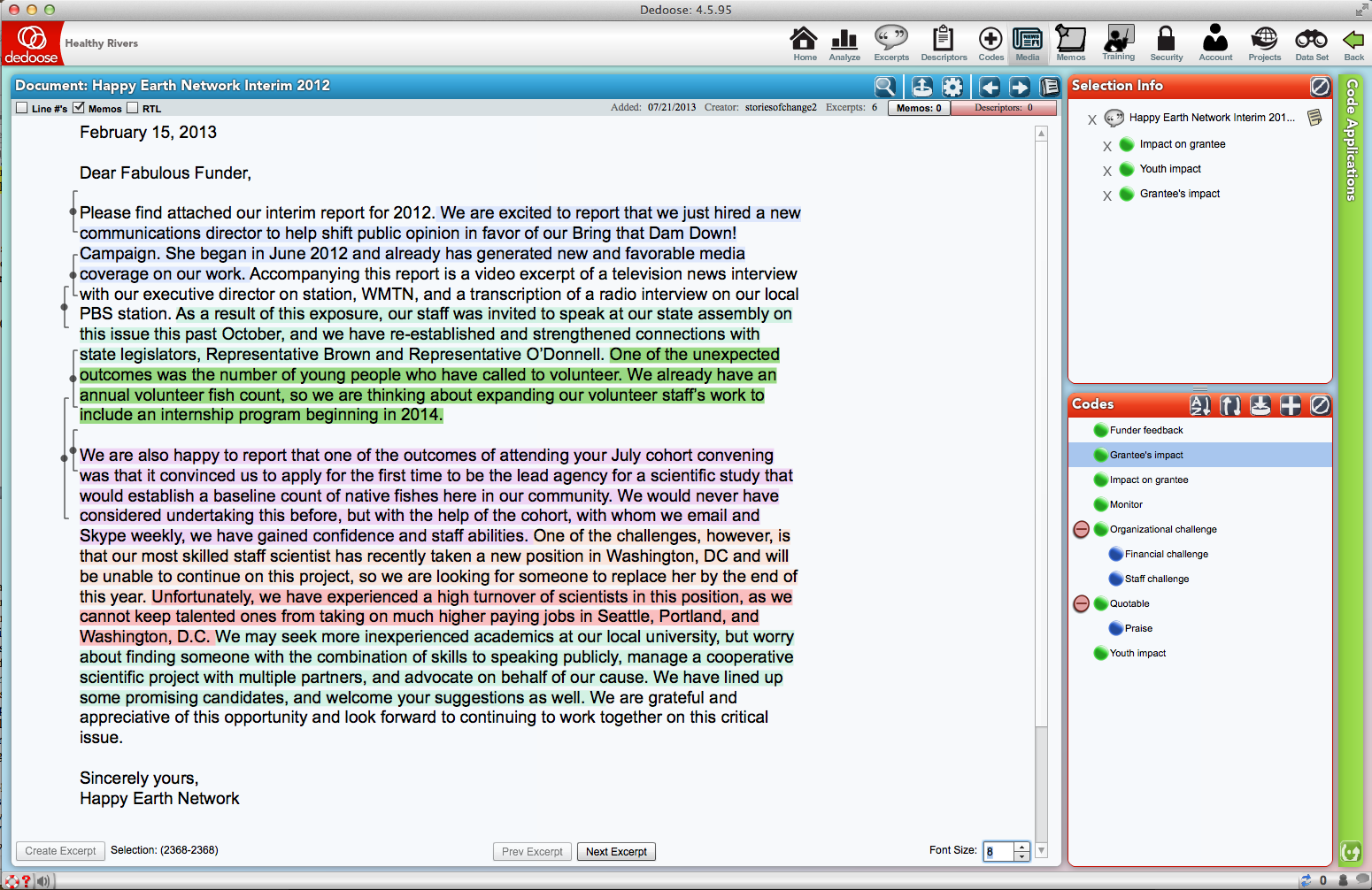
Here’s an example of coding Happy Earth Network’s interim grant report. You can see the codes I made up in the bottom right box labeled “Codes.” In the large field is the grant report. I thought that these two sentences, which I highlighted and then made into an "excerpt," indicate how Happy Earth Network used their grant, is affecting public perception, and is exciting youth attention to their cause.  Hence, I assigned the following codes: "impact on grantee," "youth impact," and "grantee's impact." You can assign as many codes as you like to your selection. The idea is that every time you want to generate a report of all content that was assigned a code, such as "impact on grantee," only this content will be gathered and displayed together, with all other content filtered out.


Here's another example: I selected these sentences (highlighted in green), which are about Happy Earth Network's current organizational challenge (they have a hard time retaining scientists in their rural, low-paying community). At some point, when I want to review all the different kinds of challenges my grantees are facing, I can generate a report of just those selections coded "staff challenge" to analyze for any trends. I also coded this same selection "monitor" to remind me that I want to follow up on how Happy Earth Network is doing with hiring and retaining skilled staff.


And, here's what the document looks like when I'm done coding. Notice that some sentences don't get any coding at all, while others (as in the examples above) got one or more codes.


It looks quite messy, but you'll never need to look at this document in this state again. (If you want to read original grant reports, remember that your grants management system is the best place for managing and reviewing this kind of material. Data analysis instruments are just for analyzing the content.) Upon coding, you can forget about reading this grant report in this long narrative format. You, or your program associate, just read it in order to code it--now you just want to be able to call up the relevant bits. As an example, let's say you want to review only information that is relevant to how your grantmaking affected your grantees. Remember you have a code for this, so you can export all data coded "impact on grantee." Here's an example of how Dedoose exports this information (you can export it as an Excel or Word document--either one makes it easy for you to cut and paste for your report writing).

I've only coded one organization in this example, Happy Earth Network, but if we had other grantees' reports, their data would also come up under this code assignment. Keep in mind that you can upload and code not only grant reports, but also your site visit notes, transcripts of recordings, reviewers' notes, media coverage--anything that can be selected as text for you to assign codes. Also, remember your descriptors? You can apply a filter for only those types of organizational characteristics you want to examine. For instance, you can review the codes of only organizations in your grant portfolio (1st descriptor) that are in the current cohort (2nd descriptor).


You can use Dedoose as an individual program officer, or this tool can be used throughout the foundation. There's healthy competition in the world of data analysis software, trying to make them easier and more powerful to use. A couple years ago, when I didn't know about Dedoose, I would never have suggested using data analysis tools for nonprofits, unless they were actually doing social science research and high-end evaluations. But, I stumbled on Dedoose for a project and found out first hand how they made this sophisticated program easy to use for any social change-oriented organization. What I love is that you can upload and code just about anything text or video based, it works on a Mac or PC, and it's remotely accessible as it is web- and not desktop-based. Dedoose will help you track, organize, and discern evidence of impact. So the next time you're asked for data about how your foundation's grantmaking is affecting your grantees or the field, you can say, "I can have it to you today!"


Tuesday, July 16, 2013

Is Criticizing Private Foundations Anti-Capitalist (i.e., Marxist) or Pro-Capitalist?


Working on a dissertation that seeks to address empirically the notion of private foundation effectiveness, I’ve been struck by two things: the lack of critical inquiry on this topic and how criticism of foundations has been stifled. On the first point, of course, people pontificating and expressing their opinions have spilled lots of ink, but much of this is subjective and reflects ideology not facts. Certainly, personal expressions by those knowledgeable about the field can be useful, but without including a critical, discourse-dependent approach to inquiry, conversations about private foundations neither become increasingly sophisticated nor elevated beyond a shouting match. This lack of scholarship is a far cry from my other academic experience, which was in art history, which I can’t help but use as a comparative foil. In my graduate studies in art history, I was bombarded with criticism—discourse on identity, how we perceive, and the notion of power and otherness. As frustrating as it was to be reading semiotics than visiting a museum, I appreciated being able to move beyond appreciating art on the basis of personal aesthetic pleasure to understanding the construction of meaning that says a lot about who we are as a people.

In building my literature review of private foundations, there is very little critical study of its effectiveness. Hence, in the absence of empirical data, I’ve been mining references for different ways in which people have critically analyzed foundations, particularly around the notions of accountability and effectiveness. In that process, I found something interesting that has no room in my study, so I’ll talk about it here instead. There’s something odd and disturbing in how people treat those who criticize private foundations.

There seems to be two kinds of treatment of people who express any kind of criticism of private foundations. One kind of reaction is to accept their criticism and laud the person for being an important voice in the field. These folks are perceived as being an intellectual scholar or enlightened leader: They are warmly invited to circulate among foundation board trustees and to speak at foundation-only conferences. Joel Fleishman (2009) falls into this camp as do many foundation CEOs and presidents who express self-critical opinions, such as “we need to do more” and “this is not our money.” When I consider why these folks are so well received within the private foundation community, it’s because they are moderate in their ideas of what foundations should be doing. Instead of calling for increased regulation, such as increasing taxes on private foundations or increasing the payout floor beyond 5%, they ask foundations to self-regulate their giving to give more to the poor, consider sunsetting, and be less secretive and more transparent. The bottom line is that their recommendations stop short of increased governmental regulation and do not upset the general social order. Take, for example, Fleishman (2009). In the same book in which he suggested that foundations should pay out more and that more foundations should sunset, he is also quite firm on the point that foundations have the Constitutional “right to disburse [funds]” in any way they choose (pp. 15-16). This “autonomous” right to freedom of grantmaking is a position that has a large following, reflected in the membership of Philanthropy Roundtable. (I may return to this topic later, as there’s also interesting going-ons with those who believe that foundations should be considered as having tax immunity (freedom from government) than tax subsidy of helping re-distribute wealth [see, for example, Reid, 2013].)

This type of critic does not upset any apple carts and, in fact, makes the case for why those in power should stay in power: Elites still get to be elites, and their ability to self-initiate any improvements in charitable practice depends on them staying in power. This notion of philanthropic elites is an important notion well established by a body of research generated by a group of smart women whose names, coincidentally, all start with “o.” Odendahl (1990), Ostrander (1984), and Ostrower (1995) studied the elites and found that their participation on nonprofit boards and their charitable giving reified their elite status, placing them in a social circle of other elites and reinforcing class divisions between high and low.

The other type of response to critics of private foundations is to accuse them as being a Marxist enemy of capitalistic and, hence, undemocratic. Take, for example, Fleishman’s criticism of Roelofs’s (2003) book “Foundations and Public Policy: The Mask of Pluralism.” Fleishman warned: “There is a small body of Marxist-oriented scholarship about foundations, much of it politically marginal and factually shaky” (cited in Van Til, 2008, p. 124). I’m both discouraged and ashamed that such a revered foundation scholar like Fleishman takes to dismissive name calling (come on, can’t we have an intellectual debate without accusing people of being a sickle-wielding communist?).

Roelofs’s work has as much of an important place on foundation executives’ book shelves as Fleishman’s works do, particularly among funders who want to redress social inequities and not inadvertently re-institute them. Roelofs (2007) perceived private foundations through a critical lens of power and social inequities (listen up all you social justice funders!). She contended that private foundations reinforce the existing social order “promoting consent and discouraging dissent against capitalist democracy” (p. 480). For example, intellectuals who are disenfranchised by the existing social order and want to promote change often find an outlet in being employed within the nonprofit sector, such as private foundations. (This pretty much describes every smart, value-forward program officer I know.) By being employed in an industry that depended on capitalism for its success, these folks are quieted by their involvement in these civil society entities, which exerts a cooling effect on the possibility of a revolution that fights against the established hegemony (Roelofs, 2007). (Hmm, maybe Egypt’s best way to stymie revolution is to proliferate its own civil society institutions!) Roelofs (2007) posited that the United States is without the kind of protest movements that marked the 1960s and 1970s because of philanthropic institutions that exert social control: “Radical activism was often transformed by foundation grants and technical assistance into fragmented and local organizations subject to elite control” (p. 485).

Does Roelofs sound like a revolutionary manifesto? Not to me, but that may be because I’ve felt personally the cooling effects of working for private foundations. Any program staff member who has worked for many years in a foundation (after the stars have fallen from their eyes) would likely find Roelofs’s message to be a no-duh, not a polemic. (Yes, working for foundations does provide wonderful opportunities to make change, but I’ll talk about those in another post.) There have been moments when low levels of wealth redistribution, which make no dent in addressing the gross inequalities and inequities in society, frustrated me. A concrete example of this is foundations’ efforts to pay out only the bare-minimum amount of 5% distribution of assets rather than give away more money to truly try and fulfill their missions. Hence, I welcome Roelofs's contribution to the literature, which helps funders be more enlightened about and effective in attempting to redress inequities--an effort that is directly in line with creating a more democratic society.

In the last decade, there has been a renewed effort for ‘social justice philanthropy’ to try and solve inequities of resources, opportunities, and power. For those of you in that camp (and anyone else), you may be interested in learning more along the lines of what I’ve written about here. This line of thinking about how foundations reflect or fight the negative effects of capitalism is important because it helps illuminate how your foundation may be accidently complicit in re-enacting injustices. The learning from these writings is the intellectual basis for how your foundation can ‘move the needle’ permanently in your funding, rather than ‘move the needle’ temporarily as so many foundations do. There is a still-too-small body of writing that critiques private philanthropy but for more, start with Robert Arnove’s writings in the 1980s. He pioneered thinking about ‘liberal’ foundations that tried to fight inequities but actually ended up re-enacting socio-economic systems in grantmaking that corroded democratic accountability in decision-making. See also the special May 2007 issue of the periodical “Critical Sociology” critiquing private foundations, which includes an article by Feldman (2007) who attests to Arnove and Roelofs’s contentions by describing how progressive journalists and nonprofits avoid scrutinizing private foundations inadvertently because of subservience to private foundation funding.

Works Cited

Feldman, B. (2007). Report from the field: Left media and left think tanks--Foundation-managed protest? Critical Sociology, 33(3), 427–446. doi:10.1163/156916307X188979
Fleishman, J. L. (2009). The foundation: A great American secret; how private wealth is changing the world. New York, NY: Public Affairs. Retrieved from http://books.google.com/books?hl=en&lr=&id=fR4IYOB9RUsC&oi=fnd&pg=PR7&dq=joel+fleishman&ots=-MY11uDRS7&sig=EK3oDOsPzDS7qq4ua7EtgRQyInA 
Odendahl, T. (1990). Charity begins at home: Generosity and self-interest among the philanthropic elite. New York, NY: Basic Books, Inc., Publishers.
Ostrander, S. (1984). Women of the upper class. Philadelphia, PA: Temple University Press.
Ostrower, F. (1995). Why the wealthy give: The culture of elite philanthropy. Princeton, NJ: Princeton University Press.
Reid, A. (2013). Renegotiating the charitable deduction. The Exempt Organization Tax Review, 71(1), 21–31. Retrieved from http://www.philanthropyroundtable.org/topic/philanthropic_freedom/a_boundary_to_keep
Roelofs, J. (2003). Foundations and public policy: The mask of pluralism. State University of New York Press.
Roelofs, J. (2007). Foundations and collaboration. Critical Sociology, 33(3), 479–504. doi:10.1163/156916307X188997
Van Til, J. (2008). Searching for critical issues in philanthropy. Nonprofit Management and Leadership, 19(1), 123–128. doi:10.1002/nml.209

 
BLOG DESIGN BY DESIGNER BLOGS